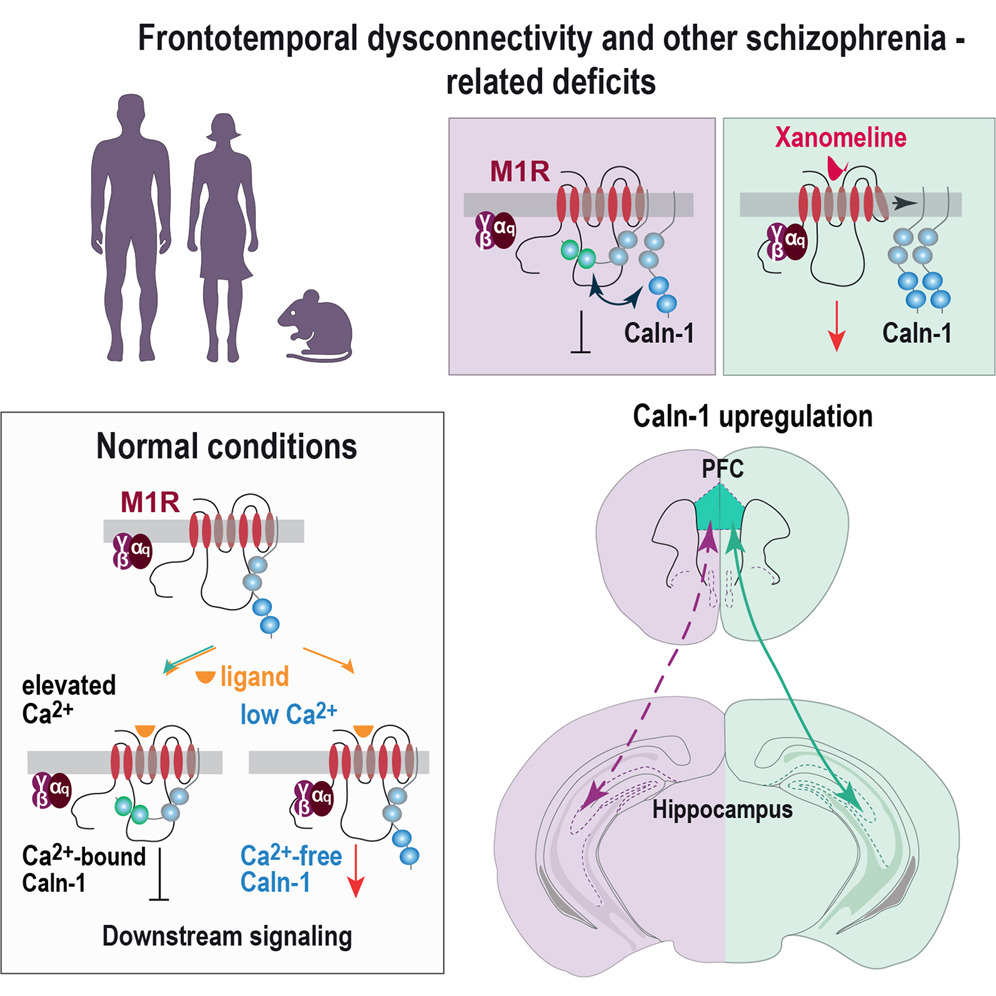
Calneuron-1 is a Ca2+ sensor that has been linked in several genome-wide association studies to schizophrenia (SCZ). We show that calneuron-1 expression is elevated in the dorsolateral prefrontal cortex of SCZ patients and that overexpression in the medial prefrontal cortex (mPFC) of mice elicits SCZ-related behavioral disabilities, disrupts rhythmogenesis within the mPFC, impairs functional connectivity between the hippocampus and the mPFC, and causes deficits in muscarinic synaptic plasticity. These neurophysiological signatures of SCZ are linked to the role of calneuron-1 as an accessory subunit of muscarinic M1 receptors (M1Rs). Calneuron-1 displaces Gαq11 from the third intracellular loop of M1R at elevated [Ca2+]i, thereby disrupting downstream signaling. The M1R agonist xanomeline, shown to reduce positive and negative symptoms of SCZ and recently approved for clinical use, impedes this calneuron-1/M1R interaction, which leads to restoration of G-protein coupling, muscarinic synaptic plasticity, and network communication. Collectively, our data indicate a potential causative pathomechanism of SCZ.
Elevated calneuron-1, an accessory subunit of muscarinic receptors, induces frontotemporal dysconnectivity and schizophrenia-like deficits, Oelschlegel AM, Pöpplau JA, Ryzynski A, Hradsky J, Reddy PP, Navarro G, Reyes-Resina I, Yuanxiang P, Sosulina L, Kaneko H, Sahu G, Günther A, Andres-Alonso M, Lopez-Rojas J, Aly AAA, Bauer P, Mikulovic S, Xia Z, Mikhaylova M, Remy S, Hanganu-Opatz I, Karpova A & Kreutz MR. (2025). Neuron